Average Ceiling Fan Speed (Rpm, Mph, Kmh)
Summer is on the fashion, too a ceiling fan is a cracking manner to go on the air in a room circulating on those steamy hot days. Maybe you’ve wondered if your existing fan is notwithstanding spinning equally fast as it’s supposed to; nosotros’ll exhibit y'all how to notice your answer.
We take the calculations to help you choose the correct fan for your room as well as, equally a bonus, a quick mode to measure your ceiling fan speed rapidly as well as accurately.


The average speed for a ceiling fan is 300-350 RPM, or 43-50 MPH, or 69-lxxx kmh. This can besides be measured equally mph or km/h, merely the near mutual measure out of fan speed is rpm. Fan speed is affected past the length of the blades, blueprint, too size. Ceiling fans come up inwards diverse sizes to suit unlike-sized rooms.
Ceiling Fan Speed Measured inwards RPM
A Ceiling fan’s blade speed is measured inwards rotations per minute, abbreviated equally rpm, RPM, rev/min, or r/minute.
RPM is an international unit of measurement of frequency used to point the issue of revolutions at which something rotates about a fixed axis inward a minute.
The international unit is used preferentially because it helps non to have to interpret the speed of the fan into metric in addition to royal units depending on what state the fan is existence shipped to. It besides makes dissimilar models easily comparable.
Still, some people prefer royal or metric measurement scales. The below calculations will permit slow conversions from RPM:
- Imperial, inwards MPH:
- Calculate fans circumference inward miles = ((two ten π (three.142) x radius (inch) ÷ 63660)
- MPH = (Circumference inwards miles ten RPM) 10 60 (minute)
- Metric, inward kmh = (Constant 0.1885 x RPM) 10 Fan Diameter (k)
What Influences Ceiling Fan Speed?
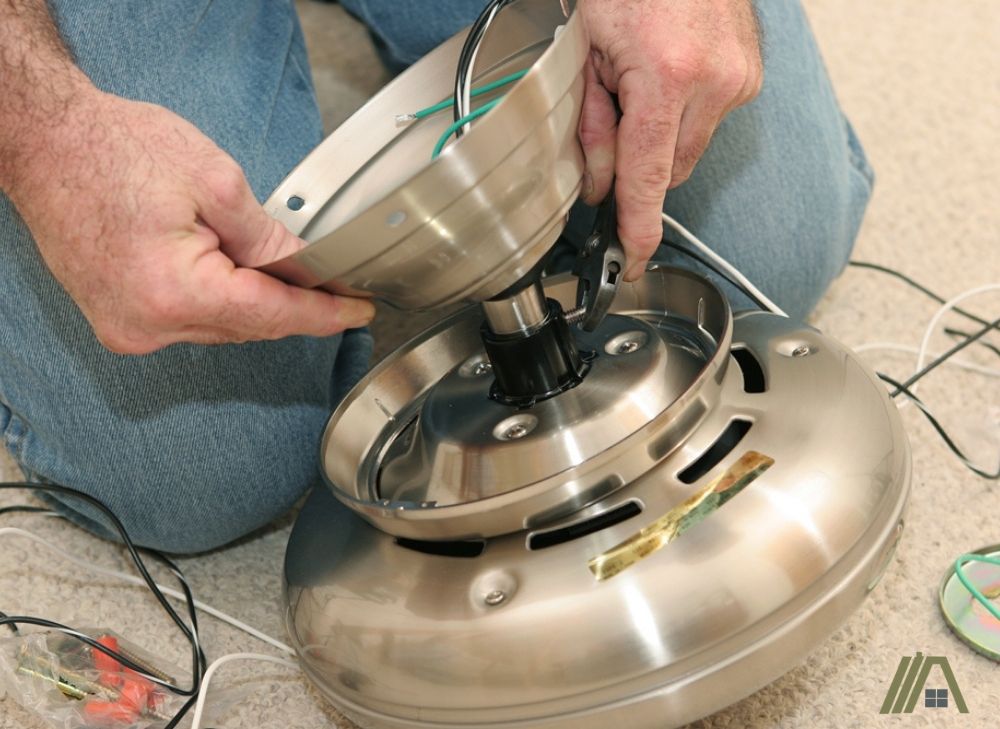
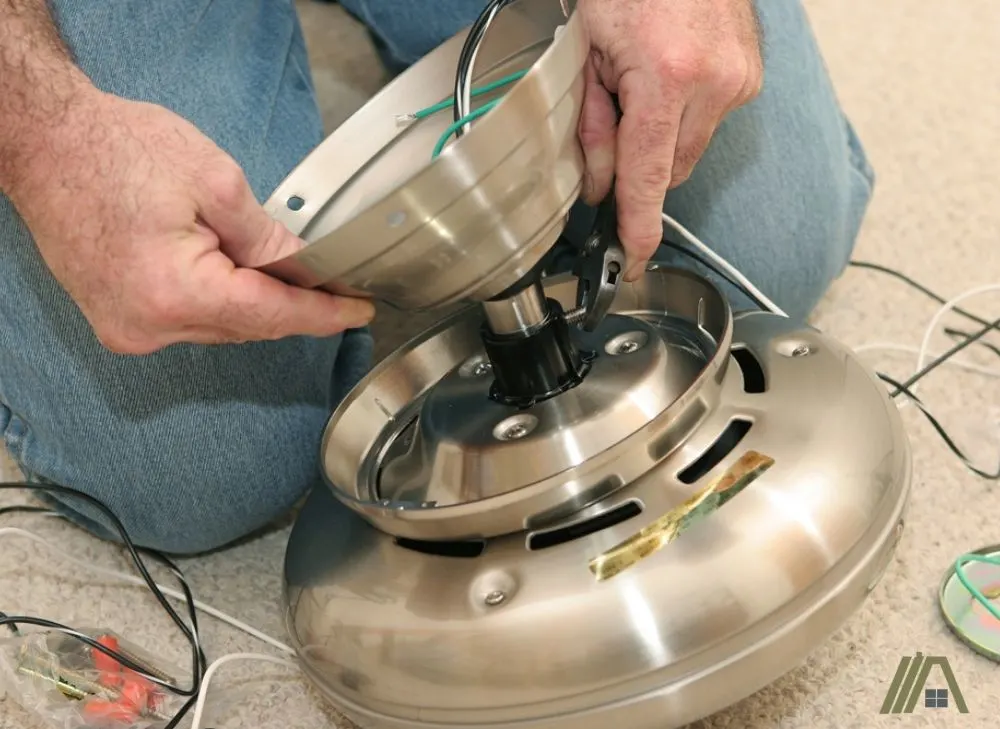
Ceiling Fan Motor
The ceiling fan motor influences ceiling fan speed. Fundamentally, the more powerful the motor, the faster the fan blades tin can rotate, and the ideal size of the fan motor is determined past the ability required to commencement the fan’sec blades turning and go on the blades turning at the desired speed.
Fan motors are made inwards many dissimilar shapes as well as sizes in addition to are either air-conditioning or DC powered. DC fan motors are up to 300 percentage more efficient than AC motors of the same size.
Ceiling Fan Blades
The fan blades themselves touch the actual speed achieved by a motor of a certain size. They too touch on the speed required for efficiency.
Ceiling blade size, cast, pitch, too number all influence ceiling fan speed together with efficiency. This is because the blades create resistance.
Resistance is what forces air to menstruation, just the resistance also way that a motor of a sure capacity will be unable to achieve the speeds it is capable of achieving without resistance.
We volition wait at each factor in isolation too assume a constant fan motor capacity inward our observations. However, inward reality, the interactions betwixt all of these factors are complex in addition to in that location is a “window” for which each human relationship is truthful.
| Ceiling fan feature | Effect on speed | Effect on efficiency |
| Motor capacity | Greater capacity = greater speed | Greater capacity = greater efficiency |
| Blade length | Longer blades = lesser speed | Longer blades = greater efficiency |
| Blade form | Paddle blades = lesser speed | Paddle blades = greater efficiency |
| Blade pitch | Greater pitch = lesser speed | Greater pitch = greater efficiency |
| Blade issue | More blades = greater resistance | More blades = greater efficiency |
Actual Relationships Are More Complex
As an instance of the actual complexity of relationships and the “window” in which the relationships are true, permit’second look at blade issue.
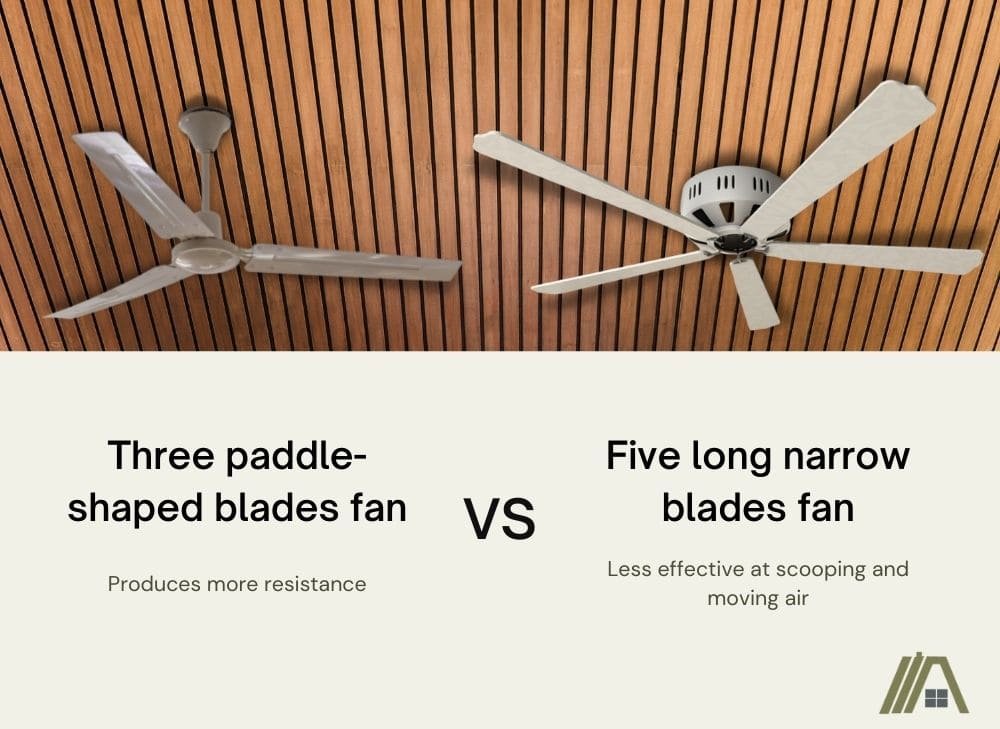
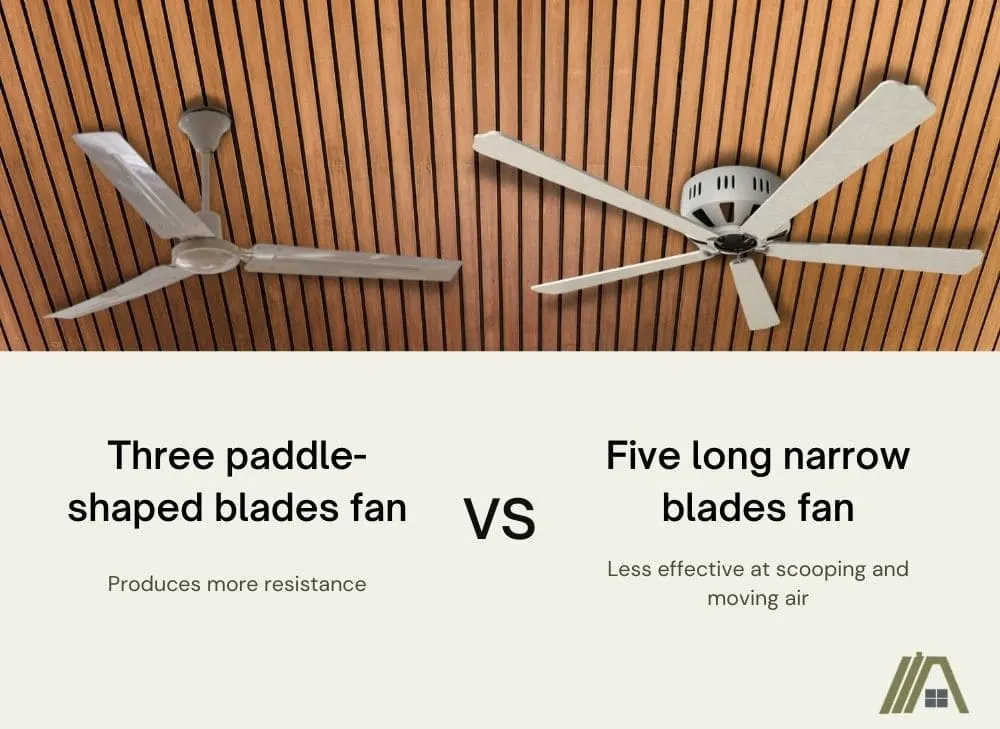
Yes, when you lot take more blades, yous increment the surface surface area of the fan, so increasing its resistance. However, if i fan has iii paddle-shaped blades in addition to y'all compare its resistance to a fan with five long together with narrow blades, you lot mightiness discover that the 3-bladed fan produces more resistance.
Additionally, because the long, narrow blades are less effective at scooping and moving air, this fan may be less efficient, fifty-fifty though it has more than blades.
Another case is that big-bladed fans tend to rotate at fewer revolutions per infinitesimal than smaller fans merely retain their effectiveness at achieving proficient airflow due to the longer blades having increased blade tip speed.
What Is the Average Ceiling Fan Speed?
The speed at which ceiling fans spin is primarily determined by the manufacturer’second design. To maximize the fan versatility, virtually are fitted with a motor that has adjustable speed settings and then that the airflow created is adaptable to the user’second preference.
The master fan speeds are tedious, moderate, together with fast. The average fan speeds are, on average, equally per the next:
- Slow: Up to 200 RPM
- Medium: Up to 300 RPM
- High: Up to 400 RPM
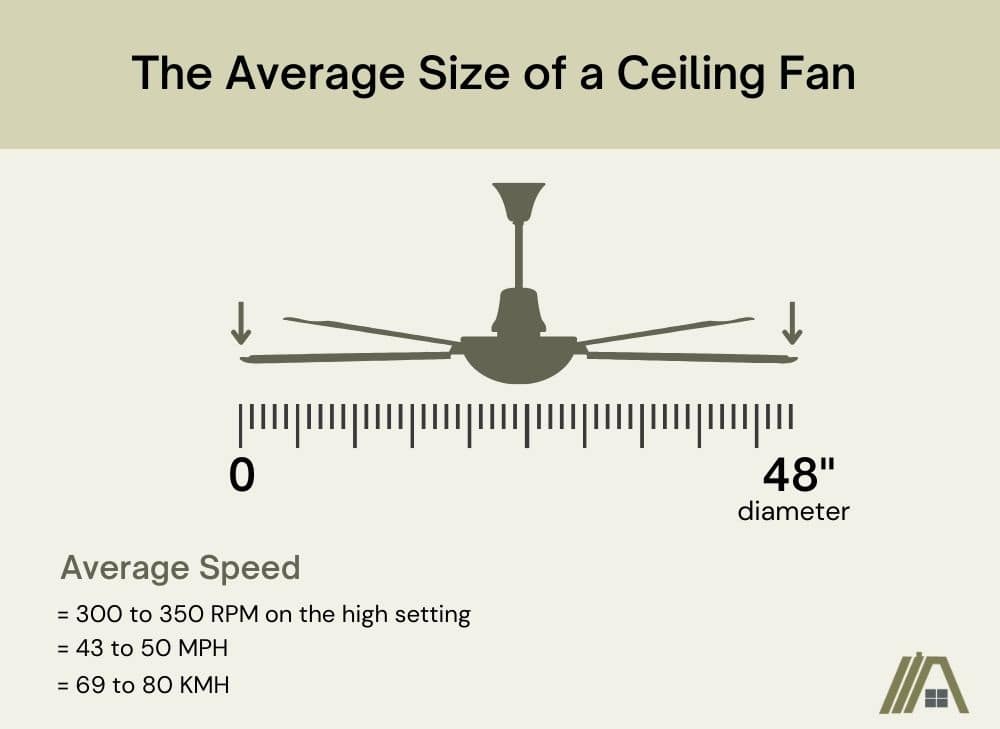
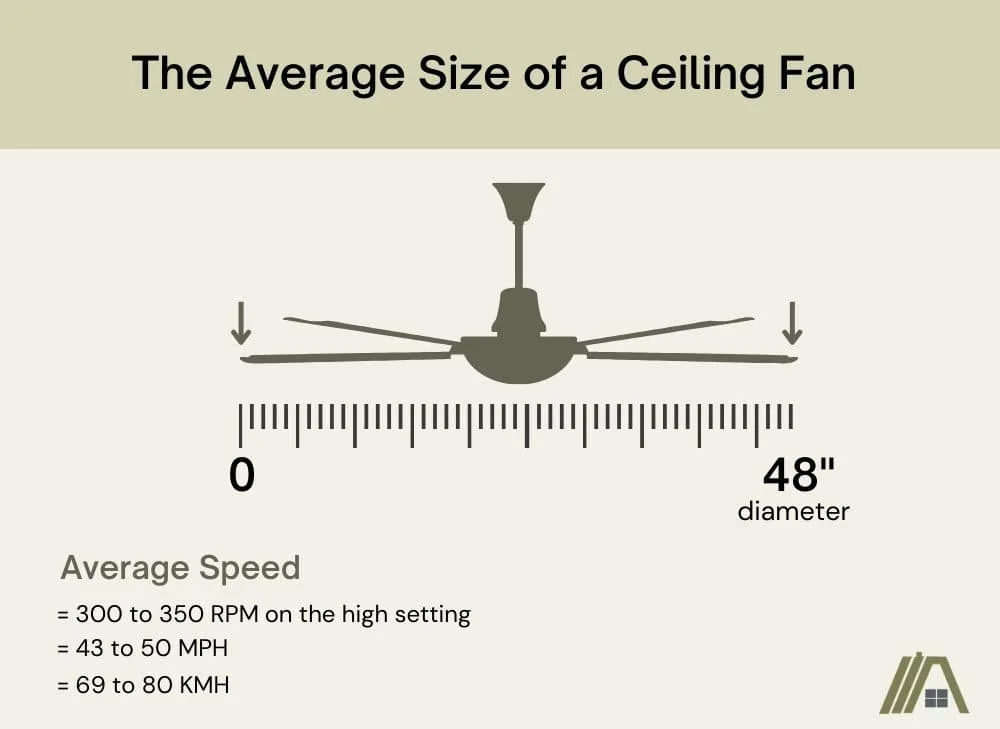
You get varying sizes of ceiling fans, merely a 48″ fan (every bit measured from the tip of i blade to the tip of the contrary blade) is considered to be the average size too and so the average speed at which it rotates tin live seen every bit the average speed of a ceiling fan.
A 48″ diameter ceiling fan runs at a speed of 300 to 350 RPM on the high setting. This is about 43-fifty MPH and 69-fourscore kmh.
RPMs for smaller fans may live higher because they typically have to rotate faster to achieve a certain efficiency of airflow. Larger fans volition have smaller average RPMs because the longer the blades, the more efficient they are alongside fewer rotations.
Each manufacturer determines the actual speed for the fan pattern, and then check the RPM rating when buying.
Maximum Permitted Speed for Ceiling Fans
UL standards regarding maximum fan speeds are pretty specific. UL 507 states that the maximum allowed speed of the fan blade tip is:
- 3200 ft/minute (36.3 MPH or 58.v kmh) for iii/16″ thick blades
- 2400 ft/min (27.two MPH or 43.8 kmh) for i/viii″ thick blades
You shouldn’t have t worry about this, though. The fan would non live saleable if it contravened this criterion.
Fan speeds are express for condom reasons due to the blades beingness exposed. Accidental contact alongside a spinning blade tin effort serious injury, and then caution is advised.
When choosing a fan, keep in listen that faster is non e'er meliorate. The pattern of the fan as well as the size besides significantly touch its functioning.
Also, the sum of noise is something to reckon. The higher the number of blades a ceiling fan has, the more than noise it’ll generate, and increasing the speed will farther increment the racket produced.
Measuring the Speed of a Ceiling Fan
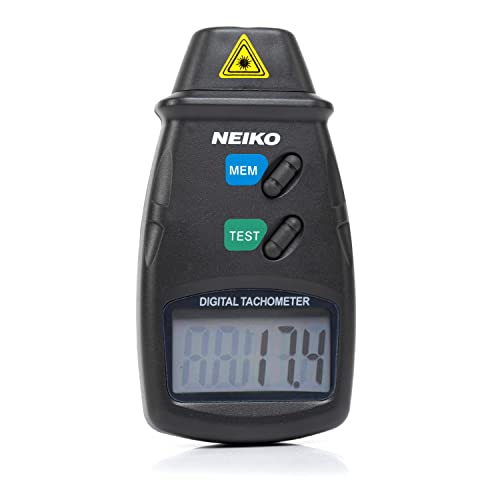
Measuring your ceiling fan’second speed tin can be easily done amongst an electronic, not-contact, handheld tachometer. The tachometer is a universal rotational measuring tool used to decide the rotations per infinitesimal for several items such every bit lathes, electrical motors, fans, as well as more.
The Neiko 20713A (amazon link) digital tachometer available online is perfect for the task. Here’sec how to measure out your ceiling fan speed inward a few slowly steps.
- Make sure the fan is turned off.
- Cut a 1″ slice of reflector tape (which should live included amongst the tachometer).
- Stick the record onto the outermost edge of ane of the fan’sec blades.
- Turn the ceiling fan on as well as allow it to achieve the operating speed.
- Turn the tachometer on as well as betoken the indicator lite at the end of the fan’s blades then the meter tin selection upwardly the reflector record equally it’s rotating (blades plow fastest on the outermost border).
- The tachometer will display the reading in RPM.
- Stop the fan too take the reflector tape.
References
https://physics.stackexchange.com/questions/86593/how-to-mensurate-speed-of-a-ceiling-fan
https://www.hunker.com/13711106/how-to-rest-a-ceiling-fan


Comments
Post a Comment